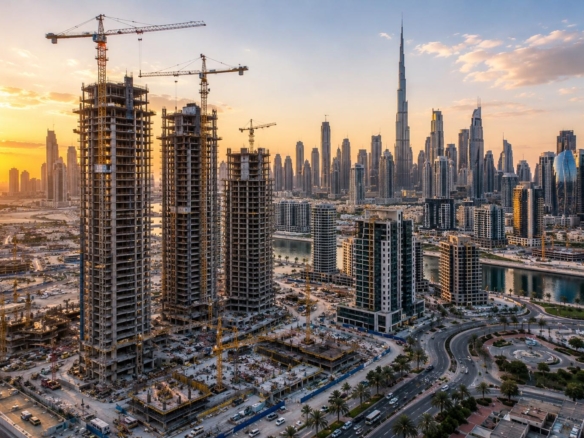
Buying an off-plan property in Dubai offers attractive investment potential, flexible payment schedules, and priority access to landmark developments. However, unexpected construction delays can create significant financial and legal uncertainty for investors, particularly when an anticipated handover date passes without clear developer communication.
When facing a Dubai off-plan project delay, buyers naturally ask critical questions: Can you terminate your Sale and Purchase Agreement (SPA)? Are you entitled to financial compensation or a refund? How does the escrow account protect your deposited funds, and what formal procedures exist through the Dubai Land Department (DLD) and the Real Estate Regulatory Agency (RERA)?
The legal answers depend on a combination of factors, including specific contractual clauses, the project’s verified construction progress, the underlying cause of the delay, and Dubai’s real estate legislation. In this comprehensive guide, Laureate Properties outlines your legal position, explains the escrow mechanism, examines applicable Dubai property laws, and provides an actionable roadmap to safeguard your investment.
In This Guide
- The Legal Reality: Construction Delays vs. Cancelled Projects vs. Contract Termination
- The Sale and Purchase Agreement (SPA): Grace Periods and Force Majeure
- How Dubai Escrow Law Protects Off-Plan Buyers
- Key Legislation Governing Buyer Rights in Dubai Off-Plan Real Estate
- Can You Cancel Your SPA or Claim Financial Compensation?
- Why You Should Not Unilaterally Stop Installments
- Step-by-Step Action Plan: What to Do If Your Project Is Delayed
- How to Reduce Delay Risks Before Signing an Off-Plan Contract
- Frequently Asked Questions About a Dubai Off-Plan Project Delay
- Conclusion: Protecting Your Dubai Property Investment

1. The Legal Reality: Construction Delays vs. Cancelled Projects vs. Contract Termination
In Dubai real estate practice, not every delayed development constitutes a project cancellation or gives the buyer an immediate right of rescission. Understanding the distinction between a construction delay, an official administrative cancellation, and contractual termination is essential before initiating any legal action.
| Category | Legal Meaning | Investor Considerations |
|---|---|---|
| Construction Delay | The development remains active and legally registered, but progress or handover is behind the anticipated contractual timeline. | Review the SPA completion date, contractual grace period, registered progress on Dubai REST, and formal developer explanations. |
| Official Project Cancellation | RERA formally issues an order cancelling the development pursuant to statutory grounds under Executive Council Resolution No. 6 of 2010. | Liquidation, debt settlement, and purchaser refund procedures fall under the exclusive remit of the Special Tribunal established by Decree No. 33 of 2020. |
| Contract Termination (Rescission) | The contractual relationship between an individual purchaser and the developer is legally dissolved. | Requires mutual consent, explicit contractual exit terms, or a binding judgment/award from a competent court or arbitration tribunal under UAE law. |
Construction Delays
Developments may encounter delays due to logistical challenges, contractor changes, infrastructure coordination, or authority approvals. An overdue estimated completion date does not mean the project has been cancelled or that the developer has forfeited its contractual mandate. As long as the project remains registered and active with RERA, the statutory and contractual mechanisms continue to govern the relationship.
Officially Cancelled Projects
An official cancellation is a formal regulatory determination. Under Article 23 of Executive Council Resolution No. 6 of 2010, RERA may cancel a real estate project under specific circumstances, such as a developer failing to commence construction without acceptable cause, gross negligence, or lack of genuine intention to implement the project. Once cancelled, the liquidation of assets and return of remaining escrow funds are administered under dedicated statutory mechanisms.
Contract Termination
Contract termination dissolves the specific agreement between the buyer and developer. A delayed handover alone does not confer an automatic right to terminate unilaterally. Any exit must be grounded in explicit contractual terms, established statutory criteria, or a final judicial ruling.
2. The Sale and Purchase Agreement (SPA): Grace Periods and Force Majeure
The Sale and Purchase Agreement (SPA) is the primary legal foundation governing your property purchase. It defines completion milestones, payment schedules, handover criteria, dispute mechanisms, and contractual remedies for delays.
Understanding the Contractual Grace Period
Most Dubai off-plan SPAs incorporate a developer grace period (often 6 to 12 months) beyond the anticipated completion date. This clause permits the developer to extend the handover window without incurring contractual breach or financial penalties. Crucially, there is no universal, statutory grace period that automatically applies across all contracts—the duration and validity depend strictly on the precise wording of your signed SPA.
Key items to verify in your SPA include:
- The baseline anticipated completion date.
- The duration and conditions of the developer grace period.
- Whether extension rights require formal written notification to the buyer or RERA endorsement.
- The contractual definition of completion (e.g., Building Completion Certificate issued by Dubai Municipality vs. physical handover).
- Whether the contract provides liquidated damages, penalties, or compensation clauses for unjustified developer delays.
Force Majeure Clauses
SPAs typically feature a force majeure clause excusing delays resulting from unforeseen, extraordinary events beyond either party’s reasonable control. Under UAE law, establishing force majeure requires meeting rigorous legal tests: the event must be unforeseeable, impossible to prevent, and render contractual execution impossible rather than merely difficult or commercially burdensome.
Routine contractor defaults, internal financial difficulties, or foreseeable supply delays do not automatically qualify as force majeure. When a developer invokes force majeure, buyers have the right to request comprehensive written evidence specifying the nature of the event, the regulatory substantiation, and the revised construction program.
3. How Dubai Escrow Law Protects Off-Plan Buyers
Dubai Law No. 8 of 2007 Concerning Escrow Accounts for Real Estate Development established one of the region’s most robust investor protection frameworks, creating strict financial governance for off-plan property transactions.
Project-Specific Escrow Accounts
Under Article 9 of Law No. 8 of 2007, every licensed developer selling off-plan units must open a dedicated escrow account in the project’s name with an approved financial institution. All purchaser installments, financing proceeds, and project revenues must be deposited directly into this account. Crucially, the law specifies that escrow balances are legally ring-fenced: they cannot be attached by general creditors of the developer, preventing developer insolvency from directly swallowing project capital.
Independent Auditing and Milestone-Linked Disbursements
Developers cannot freely withdraw capital from an escrow account. Escrow agents release payments strictly in structured tranches corresponding to verified construction milestones verified by accredited engineering auditors. Escrow agents submit regular financial statements to the DLD, which retains discretionary authority to audit accounts and halt disbursements in cases of irregularity.
The 5% Post-Completion Retention
Under Article 14 of Law No. 8 of 2007, once the developer obtains the official Building Completion Certificate, the escrow agent must retain 5% of the total escrow account value. This sum is held for one full year following the registration of units in the purchasers’ names, serving as a statutory financial reserve to address outstanding construction defects or unfinished communal snagging obligations.
Does Escrow Guarantee Timely Handover?
No. While the escrow account prevents misappropriation of funds, it does not guarantee that construction will adhere to schedule. If a project stalls, Article 15 of Law No. 8 of 2007 empowers the escrow agent, in consultation with the DLD, to take necessary measures to preserve depositors’ rights—which may include appointing another developer to finish the project or initiating statutory refund procedures.
4. Key Legislation Governing Buyer Rights in Dubai Off-Plan Real Estate
Understanding Dubai’s core legislative instruments allows purchasers to distinguish between developer construction obligations and statutory default rules.
1. Law No. 13 of 2008 and Law No. 19 of 2020
Law No. 13 of 2008 regulates the Interim Real Property Register (Oqood). It mandates that all off-plan unit sales be formally recorded in the interim register to secure purchaser property rights. Law No. 19 of 2020 amended Article 11 of this statute, establishing explicit, structured procedures that developers must follow through the DLD when a purchaser breaches payment obligations. Article 11 governs buyer defaults—it should not be confused with a mechanism governing developer construction delays.
2. Executive Council Resolution No. 6 of 2010
Resolution No. 6 of 2010 provides the executive regulations for Law No. 13 of 2008, detailing critical dispute resolution and termination procedures:
- Article 14 (Amicable Dispute Resolution): Authorizes the DLD to mediate disputes between developers and purchasers. If an amicable settlement is achieved, it is recorded in a formal agreement that becomes binding upon both parties.
- Article 20 (Purchaser Termination Grounds): Sets out the specific statutory grounds under which a purchaser may approach the competent court to request contract termination, including:
- Developer refusal, without a valid reason accepted by the DLD, to deliver the final sales contract.
- Developer refusal to link payment installments to RERA-approved construction milestones.
- Material alteration of agreed unit specifications without buyer consent.
- Substantial structural defects rendering the property unfit for intended use.
- Other fundamental breaches recognized under general legal principles.
- Articles 21 & 22 (External Circumstances vs. Developer Negligence): Clarify scenarios considered beyond developer control versus instances of developer negligence or failure in execution.
- Article 23 (Project Cancellation): Details the criteria and procedures by which RERA may officially order the cancellation of an off-plan development.
3. Decree No. 33 of 2020 and Cancelled Projects
Decree No. 33 of 2020 established the Special Tribunal for Liquidating Cancelled Real Estate Projects in the Emirate of Dubai and Settling Related Rights (succeeding the judicial committee previously constituted under Decree No. 21 of 2013). This specialized judicial body exercises exclusive jurisdiction over all liquidation disputes, escrow distributions, and creditor settlements arising from projects that RERA has officially cancelled.
4. UAE Civil Transactions Law
General contractual principles, obligations of good faith, and judicial contract rescission derive from federal law. In the UAE, the governing contract framework is the Civil Transactions Law. Federal Decree-Law No. 25 of 2025 issued a modernized Civil Transactions Law (taking effect on 1 June 2026, replacing Federal Law No. 5 of 1985). Under this framework, bilateral contracts require mutual performance, and termination without mutual consent generally requires an enforceable court order.
5. Can You Cancel Your SPA or Claim Financial Compensation?
Investors experiencing a Dubai off-plan project delay often contemplate whether they can cancel the contract or claim financial damages. The viability of these options depends on precise legal grounds and contractual language.
Can You Unilaterally Cancel the Contract?
Under UAE contract principles, a buyer cannot unilaterally terminate an SPA simply by notifying the developer via letter or email. Attempting to withdraw unilaterally without a judicial decree or explicit contractual exit clause places the buyer at risk of contractual breach. To terminate lawfully, a purchaser must either negotiate a mutual cancellation agreement or obtain a judgment from the competent Dubai court or arbitration center pursuant to Article 20 of Resolution No. 6 of 2010 or general civil law principles.
Are Buyers Entitled to Delay Compensation?
Financial compensation is not automatically awarded by operation of law whenever a project is delayed. There is no universal statutory monthly penalty that developers are mandated to pay off-plan buyers. Whether a purchaser can claim damages depends on:
- Contractual Penalties: Whether the SPA contains a specific delay-compensation clause (liquidated damages) outlining a defined penalty rate per month of unjustified delay.
- Judicial Proof of Damages: In the absence of a contractual penalty clause, a court or tribunal assesses compensation based on proving actual, quantifiable financial loss directly caused by the developer’s unjustified breach.
- Grace Period Status: Whether the delay falls inside or outside the contractual tolerance window.
6. Why You Should Not Unilaterally Stop Installments
When construction appears idle, a common buyer reaction is to withhold forthcoming installment payments. However, unilaterally halting payments without formal legal backing carries severe legal risks and can compromise your entire investment position.
Under Article 11 of Law No. 13 of 2008 (as amended by Law No. 19 of 2020), if a purchaser defaults on an installment, the developer can initiate formal statutory default proceedings through the DLD:
- The developer submits a formal notice of purchaser breach to the DLD.
- The DLD verifies the claim and serves a formal 30-day notice requiring the purchaser to remedy the payment default.
- If the default is not cured within the 30-day notice window, the DLD issues an official certificate confirming the developer’s procedural compliance and the project’s verified completion percentage.
- The developer is then legally entitled to enforce statutory remedies based on the certified construction progress:
- Over 80% Completion: The developer may enforce the contract, demand remaining balances, request public auction through the court, or terminate the SPA while retaining up to 40% of the purchase price.
- 60% to 80% Completion: The developer may terminate the SPA and retain up to 40% of the purchase price.
- Under 60% Completion: The developer may terminate the SPA and retain up to 25% of the purchase price.
By unilaterally stopping payments, an investor risks shifting from an aggrieved party into an officially defaulting purchaser. If you intend to suspend payments due to developer delays, always consult a qualified UAE real estate lawyer and approach the DLD for official mediation before altering your payment schedule.
7. Step-by-Step Action Plan: What to Do If Your Project Is Delayed
If your Dubai off-plan project delay exceeds the expected handover schedule, follow this structured, evidence-based roadmap to protect your contractual position.
Step 1: Check Official Status on the Dubai REST App
Verify the project’s actual progress using official Dubai Land Department tools rather than developer marketing communiques. Download the official Dubai REST app and search the project’s registration number to view the latest accredited inspection percentage, registered completion date, and developer licensing status.
Step 2: Scrutinize Your Sale and Purchase Agreement
Conduct a meticulous clause-by-clause audit of your SPA. Identify the baseline completion date, the precise duration of any grace period, developer notification obligations, force majeure terms, dispute resolution venues, and default consequences.
Step 3: Request Formal Written Clarification
Send a formal, documented communication to the developer’s registered customer service and legal departments. Request written confirmation detailing the specific causes of the delay, the current construction status, the formal contractual clause invoked, and a binding revised delivery schedule. Maintain full records of all correspondence.
Step 4: Engage the Dubai Land Department
If the developer fails to respond adequately or unjustified delays continue, contact the DLD. Article 14 of Executive Council Resolution No. 6 of 2010 provides an amicable conciliation mechanism where DLD officials mediate between developer and buyer to achieve an equitable resolution.
Step 5: Seek Independent UAE Legal Counsel
For prolonged delays or substantial financial exposures, consult a qualified UAE property lawyer. Legal counsel can evaluate whether grounds exist under Article 20 of Resolution No. 6 of 2010 to petition the competent court or initiate arbitration for termination and damages.
Once construction is finalized, review our detailed guide on the Dubai Property Handover Checklist to prepare for professional snagging, title deed issuance, and possession.
8. How to Reduce Delay Risks Before Signing an Off-Plan Contract
While external construction variables cannot be completely eliminated, disciplined upfront due diligence minimizes exposure to problematic off-plan developments.
Audit Developer Delivery Track Record
Examine the developer’s past completions across Dubai. Review historical delivery timelines, construction build quality, and post-handover community maintenance. Reputable master developers with established delivery credentials carry significantly lower execution risk.
Verify Project Registration and Escrow Compliance
Before transferring any deposit, verify through DLD systems that the project is officially registered, the title to the plot is secure, and an approved project-specific escrow account is active under Dubai Law No. 8 of 2007. Never transfer off-plan installment funds to corporate operational bank accounts.
Opt for Construction-Linked Payment Plans
Prioritize off-plan projects with construction-linked payment milestones rather than purely date-based schedules. A construction-linked plan ensures your capital disbursements remain strictly aligned with audited, verifiable physical progress on-site.
Obtain Pre-Signing Legal Review
Review the draft SPA with an independent legal advisor before signing. Ensure grace periods, completion definitions, force majeure terms, and compensation clauses are balanced and clearly formulated. For a comprehensive overview of buying off-plan in the UAE, explore our complete Dubai Off-Plan Property Guide.
9. Frequently Asked Questions About a Dubai Off-Plan Project Delay
What is the standard grace period for off-plan projects in Dubai?
There is no single statutory grace period mandated by Dubai law. In industry practice, developers commonly insert a 6 to 12-month extension clause in their SPAs. The enforceable duration and conditions depend entirely upon the specific terms agreed in your signed contract.
Can I cancel my off-plan property purchase if the developer misses the handover date?
Not automatically. A handover delay does not confer an immediate, unilateral right to cancel. Termination must be agreed mutually or granted by a competent court or arbitral tribunal based on recognized grounds under Article 20 of Executive Council Resolution No. 6 of 2010 or general UAE contract law.
Can I stop paying installments if construction is delayed?
You should never unilaterally cease payments without legal authorization. Halting installments may trigger purchaser-default proceedings under Article 11 of Law No. 13 of 2008 (amended by Law No. 19 of 2020), which can lead to formal notices, contract termination, and statutory forfeiture of deposited funds.
Does an escrow account guarantee that my property will be delivered on time?
No. Dubai Law No. 8 of 2007 ensures that your payments are ring-fenced exclusively for project construction and protected from developer creditors. It regulates financial administration but does not prevent operational, contractual, or logistical delays on-site.
What happens if RERA officially cancels an off-plan project?
When RERA cancels a development under Article 23 of Resolution No. 6 of 2010, the project is referred to the Special Tribunal established by Decree No. 33 of 2020. The Tribunal liquidates project assets and distributes available escrow and liquidation funds to purchasers and creditors according to statutory priority.
How can I check the official construction progress of my project?
Buyers can monitor verified construction progress through the official Dubai REST app provided by the Dubai Land Department. Enter the project name or registration number to view the official auditor inspection percentage and latest verified photos.
Can I claim financial compensation for a delayed handover?
Compensation is not statutory or automatic. It depends on whether your SPA contains a contractual delay penalty (liquidated damages) or whether you substantiate quantifiable financial harm directly caused by the developer’s unjustified breach in court or arbitration.
10. Conclusion: Protecting Your Dubai Property Investment
Experiencing a Dubai off-plan project delay can be challenging, but Dubai’s regulatory architecture provides robust legal and financial protections for investors. The escrow account framework under Law No. 8 of 2007, dispute conciliation under Resolution No. 6 of 2010, and specialized judicial oversight through Decree No. 33 of 2020 safeguard buyer capital from developer insolvency and systemic risk.
Navigating a construction delay requires a disciplined, factual approach: verify official progress via Dubai REST, review your SPA terms thoroughly, maintain formal written communication with the developer, avoid unilateral payment defaults, and engage professional legal and real estate advisors when necessary.
Protect Your Real Estate Investment with Laureate Properties
Whether you are evaluating a new off-plan development, conducting developer due diligence, or reviewing contractual terms before signing, informed decisions begin with objective market insight.
At Laureate Properties, our advisory team assists international and local investors in selecting premium Dubai developments with verified delivery credentials and transparent commercial terms.
Explore our curated selection of Dubai Off-Plan Properties or contact Laureate Properties today for expert guidance on your real estate portfolio.
Official Legal References
For official legislative texts, consult the official Dubai Legislation Portal references below:
- Dubai Law No. 8 of 2007 Concerning Escrow Accounts for Real Estate Development in the Emirate of Dubai
- Dubai Law No. 19 of 2020 Amending Law No. 13 of 2008 Regulating the Interim Real Property Register in the Emirate of Dubai
- Executive Council Resolution No. 6 of 2010 Approving the Implementing Bylaw of Law No. 13 of 2008
Disclaimer: This article is prepared for general informational and educational purposes only and does not constitute formal legal or financial advice. Real estate rights, contractual liabilities, and statutory remedies depend upon the specific provisions of your individual contract, factual circumstances, and applicable legislation. Investors should consult a qualified UAE legal attorney for advice concerning specific disputes. In the event of any discrepancy between English translations and official Arabic legislation, the official Arabic legal text published in the Official Gazette prevails.